[The follow is an excerpt from my Memoir/Research/Expose on Redacted Science. Doctors said my cortisol was fine. The labs said “normal.” But I knew better.
This is the story of what those tests missed — and what they actually revealed. It’s about the hidden structure of survival, when the endocrine system doesn’t fail… it’s harvested.
I explain how cortisol stayed present even after the adrenal glands were gone. And why that’s not a contradiction — it’s the blueprint of fungal control.
This isn’t just about cortisol. It’s about how the entire system adapts under pressure. And how the lab results we trust most may be the most misleading when the invader is intelligent.]
I knew cortisol was a huge part of this whole progression.
Early on, I suspected the adrenal system wasn’t just involved — it was being repurposed. That’s why, unlike most patients, I asked for cortisol tests repeatedly. In fact, I paid for some of them out of pocket, just to get a glimpse of what was happening.
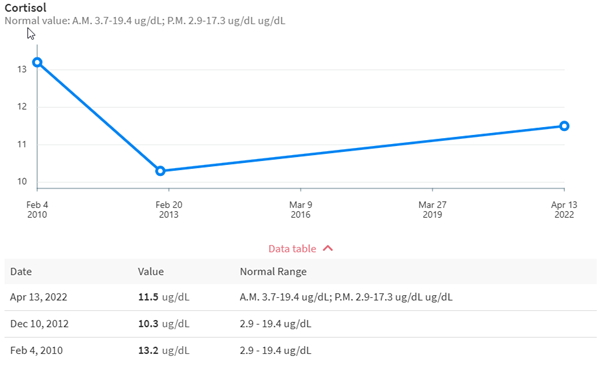
Here’s a snapshot of three of those tests over time:
At first glance, this data seems normal-ish. A doctor would see this and shrug. Nothing’s “out of range.” It’s another test that, on paper, means nothing. But that’s because it’s measured wrong.
🧪 How Cortisol Is Supposed to Be Tested
Cortisol has a rhythm — a sharp spike in the morning, then a gradual taper through the day. This is called the diurnal cycle.
To actually interpret cortisol levels, you need timing, context, and multiple samples over 24 hours — often with salivary or stimulation testing. I asked for stimulation testing for years. No one around here even does salivary testing (if they do it was not offered). To get to that level, you need “something wrong.” Need an endocrinologist visit? 6 months. But the trick is, they get to decide to say NO. And that’s what they told me. They called and said they didn’t see anything that indicated endocrinologic involvement. Then they hung up.
Your average family doctor? They just run a single blood draw, often mid-morning or late-morning. No stimulation. No phase reference. No cycle tracking.
So what you get is a statistical artifact: a number that fits the “normal” range, with no idea whether it came from a failing adrenal, a flooded backup system, or a last-ditch stress spike.
🧬 If I Had No Adrenals… Why Do I Have Cortisol?
That’s the paradox.
If adrenal function were truly gone, I shouldn’t have any cortisol.
But I do. And not just in 2010 — I still had measurable cortisol as late as 2022.
Look at the dip at the 2013 transition point — that was real. My body dropped hard. But after that? It climbs again.
So what’s going on? This is where Redacted Science steps in: Maybe the pituitary overrode the system Maybe residual adrenal cells picked up the slack Maybe cortisol was stockpiled and slowly dumped
Or maybe — just maybe — the invader rewired the entire chemistry The labs don’t tell you that.
But the patterns do. This wasn’t noise.
It was controlled degradation — and cortisol was part of the script.
🧠 Cortisol Without Adrenals? Here’s How
It sounds impossible: cortisol — the survival hormone — showing up when the adrenal glands are gone, consumed, or collapsed.
But in this condition, impossibilities keep turning out to be adaptations.
Here’s how cortisol persists when the system that should produce it is visibly absent — ranked from possible contributors to core mechanisms.
- Inflammatory Steroid Substitutes
Late-phase survival brings out strange chemistry.
Tissues such as the thymus, skin, or immune cells can locally produce corticosteroid-like compounds under extreme stress. These aren’t true cortisol, but they mimic its effects well enough to reduce inflammation, regulate energy, and suppress immune chaos — briefly. 📉 Not enough to stabilize you long-term, but enough to buy time during collapse.
- Residual or Ectopic Adrenal Tissue Humans can develop with scattered adrenal cell clusters — embryological leftovers. These ectopic adrenal cells may sit along the gonads, kidneys, or spine, and while dormant under normal conditions, they can activate under extreme ACTH pressure.
In this model, the pituitary’s overdrive may have lit up these hidden auxiliaries — a backup system few clinicians ever consider.
-
Biochemical Hoarding Your system shows signs of molecular hoarding: fluids, ketones, blood volume, and energy retention. Cortisol — bound to proteins or stored in tissue — may have been preserved during earlier, more functional phases. As collapse advanced, those reserves were released, giving the illusion of functional output… until depleted.
-
Pituitary Override (The General Takes Command) The pituitary — the General — does not give up easily. When one adrenal failed and the second was hanging by a thread, the pituitary likely initiated full override. ACTH output didn’t just increase — it cascaded through the body, possibly outside vascular boundaries, forcing any remaining adrenal tissue to continue producing cortisol at cellular cost. 🔧 Imagine bypassing a broken machine by spinning its engine manually — inefficient, exhausting, but still functional for a time. This “override” might involve physical fracture — a pituitary split or structural compromise. Whether microgranuloma separation or literal tearing, the metaphor holds: This was a last stand.
-
💡 The Invader Rewired the System ✅ At the core of your model is a fungal invader — not passive, but strategic. It doesn’t want the host to panic. It wants the host to survive long enough to be harvested efficiently. So it hijacks cortisol logic: Mimicking anti-inflammatory signals Suppressing immune detection Calming the system to extend usable time That calm you feel near the end? It’s not false. It’s not psychosis. It’s chemical containment. Not created by you — but for you, by something else. A survival extinct. I’m sure the fox felt it too.
🔬 Not Enlarged — Consumed In classical endocrinology, adrenal stress leads to hypertrophy — gland enlargement.
But not here.
No swelling. No inflammation. Just… gone.
This isn’t failure. It’s harvest.
The adrenals weren’t overworked — they were recycled.
The article noted that no adrenals were enlarge upon initial examination and only dissection revealed the extent of the damage. [Another easily missed signal]
🧬 Bit by bit, the glands were metabolized from within.
The Invader likely spared enough cortical tissue to avoid systemic crash — maintaining just enough function to suppress symptoms — while gradually extracting adrenal stem cells, cholesterol intermediates, and cortisol-producing zones.
The same script it applies later with the pancreas.
This explains: Why cortisol persists even without visible glands
Why no scans show enlargement
Why the system fails quietly
And why the mind remains stable as the body fails
It’s not dysfunction.
It’s design.
It’s fungal resource management — with hormonal camouflage.
📦 Full Archive https://ipfs.io/ipfs/bafybeihla3exmohpny755btuwqlvsec6brjwcwjvkr7fesxor6coxygam4
📘 Related GitBook Entry https://redacted-science.gitbook.io/redacted-science
#Cortisol #EndocrineFailure #FungalAdaptation #OpenMedicine #RedactedScience